True Food Kitchen bankruptcy closes its Reston Town Center restaurant
The 9,379-square-foot Reston location was among 12 restaurants closed as the health-focused chain filed Chapter 11 and began pursuing a court-supervised sale. Virginia locations in Fairfax and Arlington remain open.
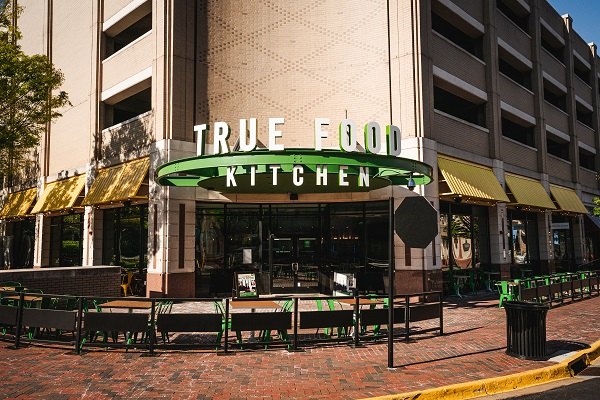
True Food Kitchen has permanently closed its Reston Town Center restaurant as part of a Chapter 11 restructuring that eliminated 12 of the chain’s 46 locations.
The Reston restaurant served its final customers October 4, the same day FRC Balance, LLC, which does business as True Food Kitchen, and eight affiliates filed voluntary bankruptcy petitions in the U.S. Bankruptcy Court for the Southern District of Texas, Houston Division. The case, No. 26-90806, is before Judge Christopher M. Lopez.
The company said its remaining 34 restaurants across 14 states will continue operating while it pursues a court-supervised sale. Virginia locations at Mosaic District in Fairfax and Ballston Quarter in Arlington remain open.
The filing is a restructuring and sale process, not a Chapter 7 liquidation. True Food is seeking to preserve the operating business while reducing costs and shedding underperforming leases.
A large Reston investment ends after five years
The Reston restaurant opened April 28, 2021, at 11901 Democracy Drive after a pandemic-related delay of about nine months. Company materials described 9,379 square feet of dining space with an open kitchen, patio and private-event capacity.
The Garden Room could seat up to 44 guests, while the courtyard patio could seat up to 76. The restaurant also had a dedicated entrance and pickup area for takeout and online orders, reflecting changes in restaurant design during the pandemic.
Its closure removes a full-service health-focused concept and private-dining venue from Reston Town Center. As of mid-October, neither True Food nor the landlord had announced a replacement tenant.
The company did not disclose how many Reston employees were affected or whether workers were offered transfers to the surviving Fairfax and Arlington locations. The closure notice thanked employees and customers, while chief executive Jeff Chandler acknowledged the effect on workers at the 12 closed restaurants.
$42.1 million in funded debt
The first-day declaration of chief restructuring officer Nathan Cook describes approximately $42.1 million in material funded debt obligations. A related filing seeking approval of the bankruptcy loan puts the company’s funded and debt-like obligations at about $41.1 million.
The company secured a commitment for about $20 million in debtor-in-possession financing from HumanCo TFK IV, structured as $5 million on an interim basis and $15 million on final approval, subject to the court.
That financing, combined with cash from ongoing operations, is intended to fund the business through Chapter 11 and a sale. True Food also filed first-day motions seeking authority to pay wages and benefits, maintain certain guest programs and continue relationships with vendors and business partners.
Cook, a Teneo managing director, said many restaurants are profitable and occupy desirable locations, but others struggled with lower-than-expected foot and vehicle traffic or with changing market conditions and demographics.
The declaration also described significant management turnover that led to shifts in growth strategy, brand strategy and menu; expansion into product lines and concepts that it called unsuccessful and outside the company’s core mission; and equipment purchases poorly aligned with its health-focused brand identity. Pandemic-era experiments with ghost kitchens and a single off-site, delivery-only kitchen, since discontinued, impaired staffing and the service experience before the company returned its focus to conventional dine-in operations.
The sale will determine the remaining footprint
True Food was co-founded in 2008 in Phoenix by physician and author Andrew Weil and restaurateur Sam Fox, built around Weil’s anti-inflammatory diet. It began inside Fox Restaurant Concepts and was spun off as FRC Balance in 2017, which is why the debtor carries that name. The chain expanded to 46 restaurants before the October closures.
The company hired Chandler as chief executive in July and retained Gordon Brothers as real estate advisor and Teneo as financial advisor. Chapter 11 gives the company a process for selling the enterprise, rejecting leases and stabilizing the surviving locations.
For Virginia landlords and vendors, the key issue is whether the sale preserves the two remaining restaurants and their existing contracts. A buyer could acquire the operating business while negotiating further lease changes, although the company has not announced additional Virginia closures.
Gift cards, loyalty benefits and catering obligations also require monitoring. True Food has asked the court to maintain certain guest programs, but customers and event clients should confirm the status of balances and future reservations directly with an operating location.
The Reston closure illustrates the local effect of a national restructuring. A restaurant that once represented a large build-out, more than 9,000 square feet of leased space and multiple revenue channels disappeared in a single bankruptcy weekend. The surviving Virginia restaurants remain open, but their long-term ownership and lease status will depend on the court-supervised sale.