The MBAR, explained: what Virginia asks you to prove every year
The Mixed Beverage Annual Review is due on your license anniversary, not a fixed date, and the records it depends on have to be built months earlier. Here is what it is and where operators get caught.

Every mixed beverage licensee in Virginia files a report documenting food and beverage sales. It is called the MBAR, the Mixed Beverage Annual Review, and it is the mechanism by which the Commonwealth checks whether you are running a restaurant that serves drinks or a bar with a token kitchen.
Most operators know it exists. Fewer know when theirs is due, and fewer still have records built in a way that survives the question.
It is not due in January
This is the single most common misunderstanding.
There is no statewide MBAR deadline. Your review is due on the anniversary of your license issuance. A license issued March 12 reviews in March. A license issued October 1 reviews in October. If you took over an existing operation, your anniversary may not be the date you think it is.
Find the issuance date on your license and put a recurring reminder sixty days before it. Not on it. Sixty days before, because the work is not the filing, it is the records.
What it measures
The MBAR documents food and nonalcoholic beverage sales against alcohol sales for the review period, and tests them against the food requirement.
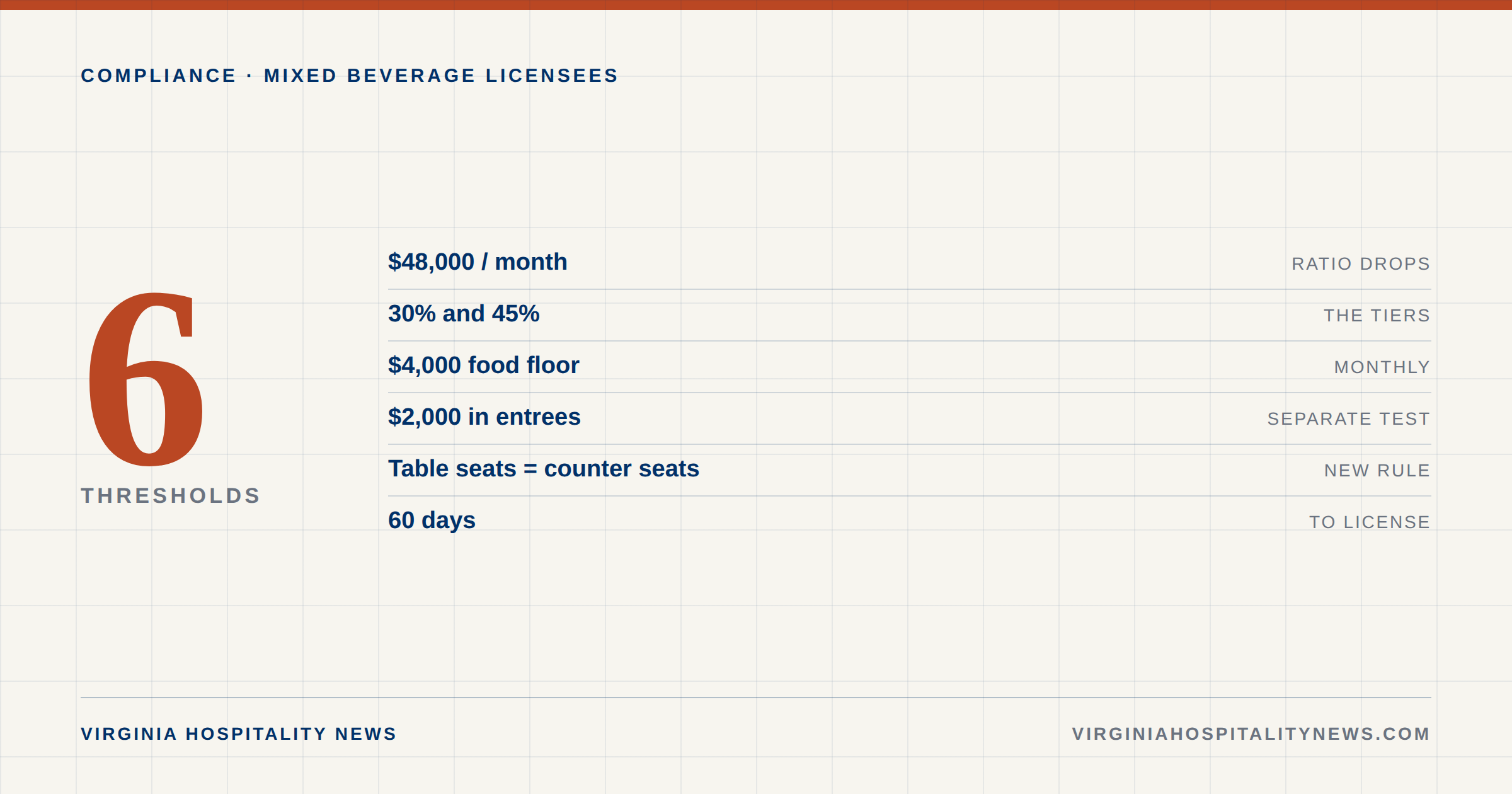
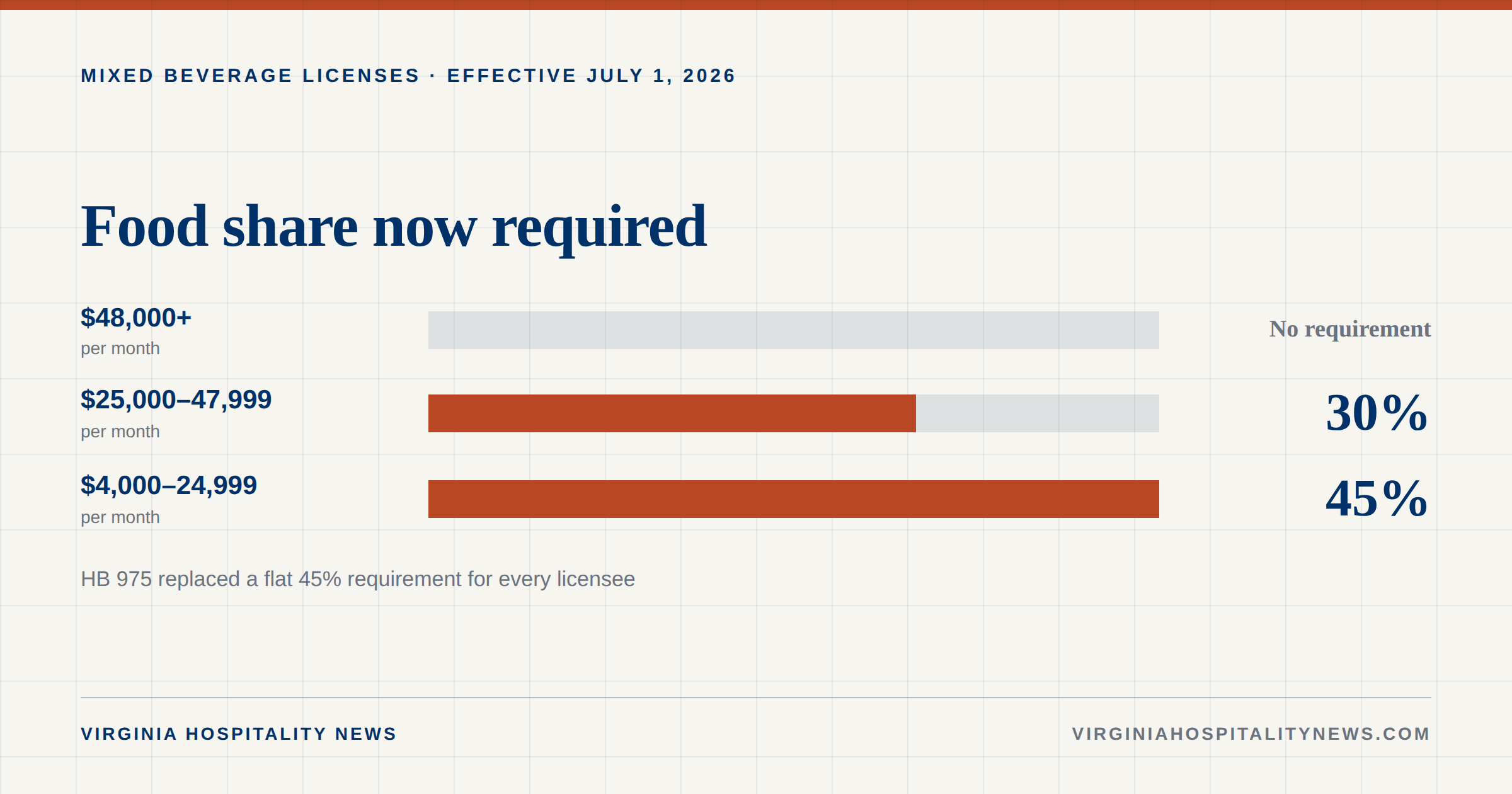
That requirement changed on July 1, 2026. HB 975 replaced the flat 45% standard with tiers keyed to monthly food sales: no ratio requirement above $48,000 a month, 30% between $25,000 and $47,999, and 45% between $4,000 and $24,999, with a drop to 30% for very small rooms. We covered the tiers and the new seating rule here.
One caution worth stating plainly: published guidance and statute have been moving faster than the explainer pages. Virginia ABC web pages, trade association summaries and this article have all lagged the statute at some point this year. Check the date on whatever you are reading.
The floors underneath the ratio
The tiers get the attention. The floors get people.
Regardless of ratio, a mixed beverage licensee is expected to hit at least $4,000 in monthly food sales, with at least $2,000 of that in meals featuring substantial entrees. Those are different tests, and an operation can pass the first while failing the second.
Read that second number carefully. A room doing $4,500 a month in appetizers, bar snacks and desserts can clear the food total and still fail, because the entree requirement is a separate bar. If your food program is mostly small plates, this is the number to watch.
Cocktails to go do not count
When to-go cocktails became permanent, a lot of operators quietly assumed the revenue helped their food ratio. It does not. Cocktails-to-go sales cannot count toward the food requirement, and ABC expects them tracked separately.
If your point of sale lumps to-go cocktails into a generic beverage bucket, your MBAR math is wrong right now and you will not find out until someone asks.
The records, not the report
The report is a summary. What ABC actually expects is that you keep regular, accurate records on site, immediately available for review. Immediately available means when a special agent asks, not next week when your bookkeeper is back.
Practically, that means your point of sale needs clean separation between:
- Food
- Nonalcoholic beverages
- Beer
- Wine
- Mixed beverages
- Cocktails to go
Beer and wine sales do not count toward the mixed beverage ratio. If those categories are not cleanly split in your POS, you cannot prove which tier you are in, and the burden of proof is not on ABC.
There is also a quieter expectation around buffets: that food put out was actually consumed by customers. An operation running a buffet should think about how it would demonstrate that.
Where operators get caught
Assuming a fixed deadline. It is your anniversary.
Dirty POS categories. The most common cause of a bad MBAR is not bad performance, it is unprovable performance.
Counting the wrong revenue. Beer and wine do not help. Cocktails to go do not help.
Passing the total, failing the entrees. Two separate floors.
Finding out at review time. The MBAR measures a year that has already happened. By the time you are filling out the form, every month it covers is closed. This is a monthly management number, not an annual paperwork exercise.
What to do this week
Pull the last twelve months of sales, split into the six categories above. Calculate your food share month by month, not as an annual blur, and see which tier each month lands in. If any month is close to a line, you have a management problem to solve now, while you still have months left to move the number.
Then find your license issuance date and set the reminder.
The arithmetic above is yours to do, and nobody is going to do it for you.