
Virginia hotels posted a 7% RevPAR gain in September, and half the state's regions went backwards
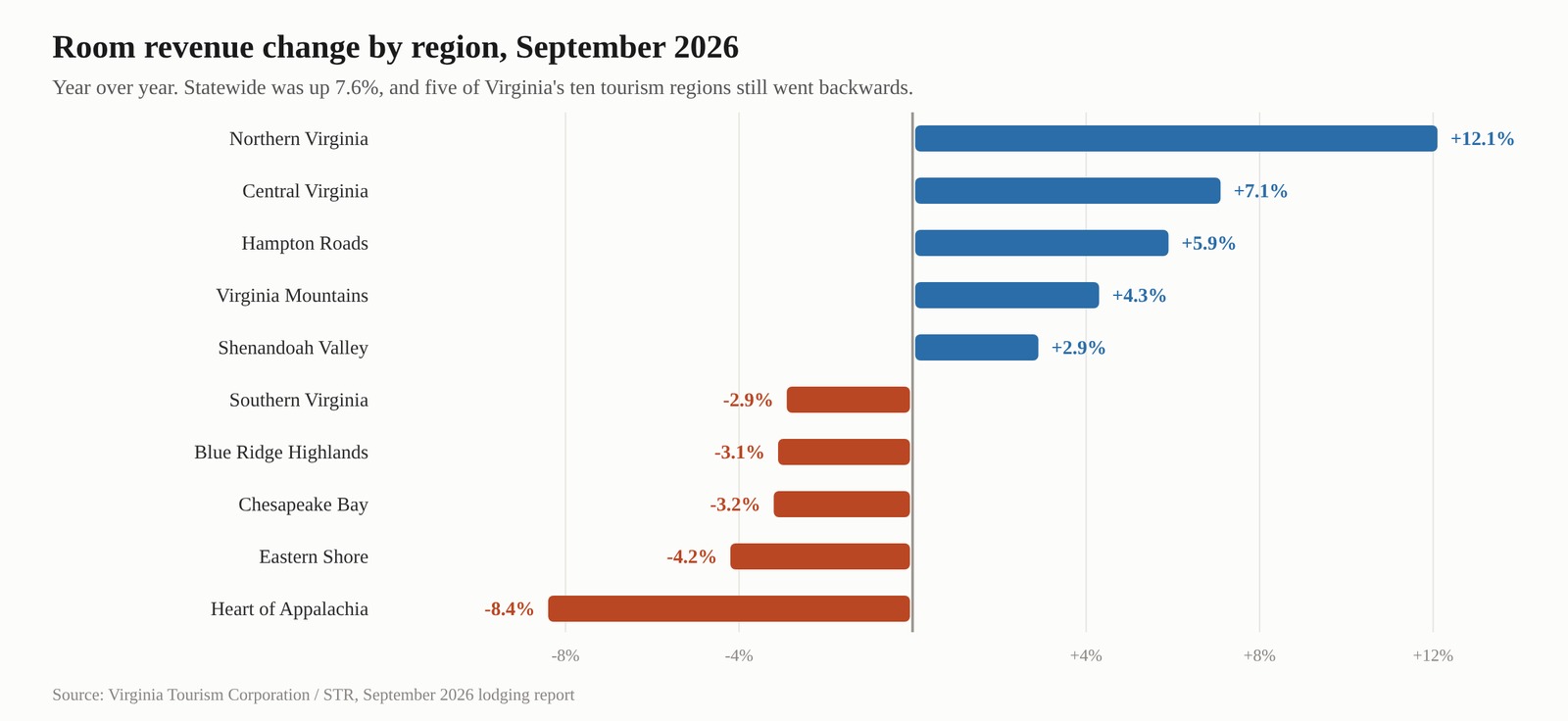
The state's September lodging report shows occupancy, rate and revenue all up statewide. Underneath that, five of ten regions lost room revenue year over year, with Heart of Appalachia down 8.4%.
Virginia hotels finished September with occupancy at 65.8%, an average daily rate of $140.04 and revenue per available room up 7.0%, according to the state’s monthly lodging report.
Those are the headline numbers, and on their own they describe a healthy month. Occupancy rose from 63.8% a year earlier. ADR rose from $134.96. Total room revenue was up 7.6%.
The regional detail is a different story, and it is the part worth an operator’s attention.
Five regions of ten lost room revenue
Northern Virginia led the state with room revenue up 12.1%. Central Virginia gained 7.1% and Hampton Roads 5.9%.
Against that, Heart of Appalachia room revenue fell 8.4%, the Eastern Shore 4.2%, Chesapeake Bay 3.2%, Blue Ridge Highlands 3.1% and Southern Virginia 2.9%.
A statewide average that combines a 12% gain in the urban corridor with an 8% loss in the far southwest is arithmetically correct and operationally misleading. For a property in Big Stone Gap or on the Eastern Shore, the statewide RevPAR figure describes somebody else’s September.
Why the split matters heading into winter
September is a shoulder month in most of Virginia’s leisure markets and a strong one in its business and group markets. A result that concentrates gains in Northern Virginia and Central Virginia while rural and coastal leisure regions decline is consistent with group and corporate demand carrying the state while discretionary leisure travel softens.
That pattern has a direct consequence for the fourth quarter. Markets that depend on leisure drive-in business are entering their weakest season from a weaker position, while the regions that gained are the ones with meeting and corporate demand to sustain them.
It also complicates how operators read the state’s tourism messaging. Virginia had a record year in visitor spending, and that is true. It is true at the same time as five regions losing room revenue in September.
What the report does not tell you
The lodging report is survey-based and reports regional aggregates. It does not break out property class, so a region’s decline may be concentrated in economy properties while upscale holds, or the reverse. It does not separate group from transient. It does not report length of stay.
Operators comparing their own September against these figures should compare against their region rather than the state, and should be aware that a single large property opening or closing can move a smaller region’s aggregate noticeably.
The Virginia Tourism Corporation publishes the monthly reports, along with the underlying data file, on its research pages. October figures typically post in late November.