Richmond may ask Virginia to lower the DUI limit to 0.05%, and restaurants are not yet part of the debate
A Richmond commission wants the city to seek a lower blood-alcohol threshold in the 2027 General Assembly session. It is not yet an official city position, but it could change the legal line for any Virginian who drives after drinking.
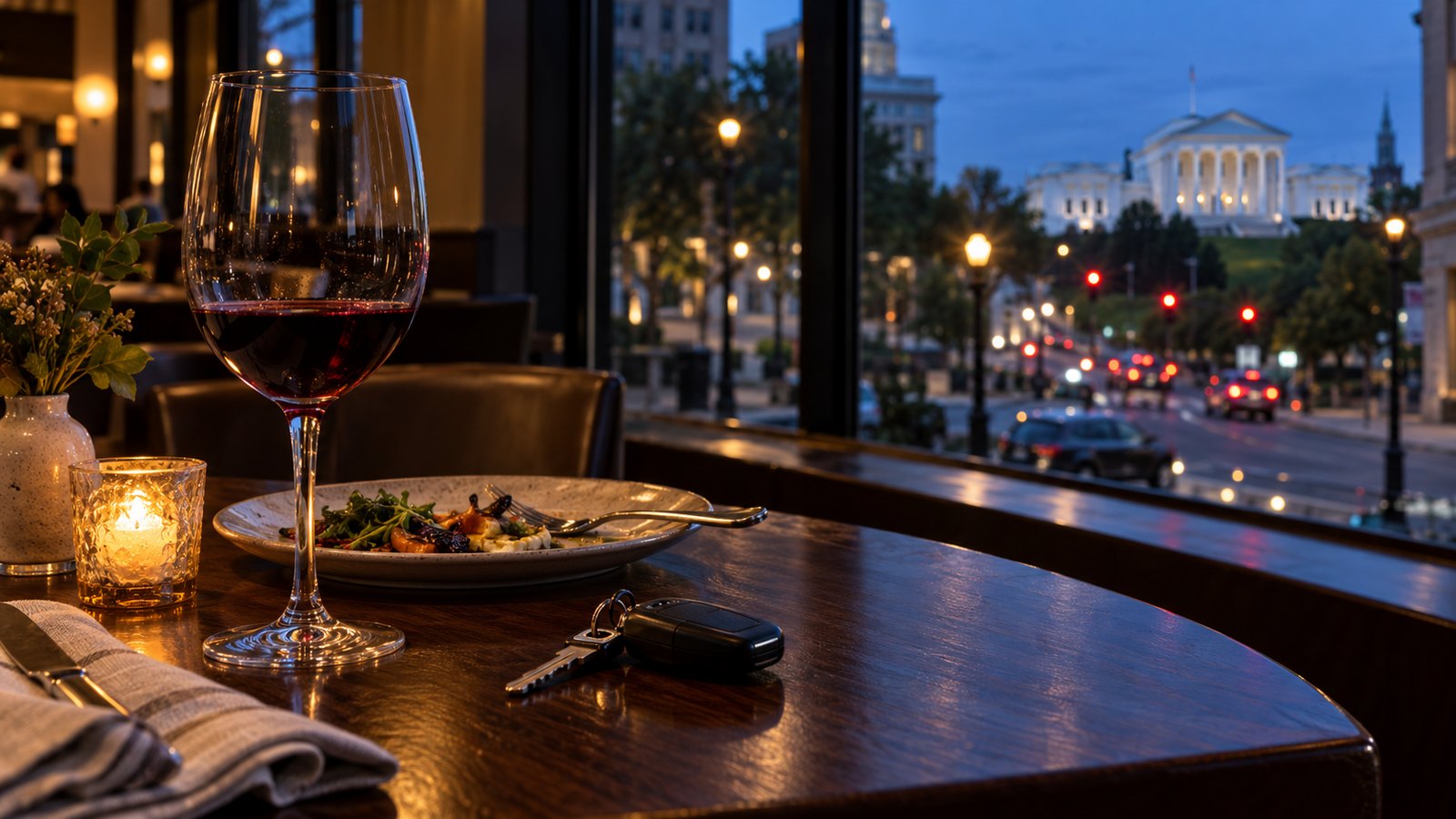
A Richmond traffic-safety commission is recommending that the city ask the General Assembly to lower Virginia’s per se blood-alcohol concentration threshold for driving from 0.08% to 0.05%, a change that would place the Commonwealth at the center of a national debate with direct implications for restaurants, bars, breweries, wineries and other businesses that serve alcohol.
The recommendation has not become an official City of Richmond position. Richmond’s 2027 legislative agenda has not been finalized, no state lawmaker has agreed publicly to carry a bill, and no proposed bill language is available.
The idea is nevertheless further along than a passing reference in a planning document. Richmond’s Safe and Healthy Streets Commission has recommended pursuing the change during the 2027 legislative session and adopted a resolution calling for City Council to work with the General Assembly on the issue, 12 On Your Side reported. The lower threshold also appears in a draft update to Richmond’s Vision Zero plan, according to Axios Richmond, which first reported the proposal.
Richmond has committed to eliminating traffic deaths and serious injuries by 2030. City data cited by Axios show that alcohol was involved in 37% of Richmond’s 159 traffic deaths from 2017 through 2025. In 2025 alone, alcohol was associated with nine of the city’s 21 traffic deaths, or 43%.
For Virginia’s hospitality industry, the immediate issue is not whether impaired driving should be prevented. Restaurants and alcohol licensees already operate under laws prohibiting sales to intoxicated customers. The unanswered question is how a substantially lower per se driving threshold would affect customer behavior, employee training and the practical decisions made during an ordinary meal or evening out.
So far, that perspective is largely absent from the public debate. No public position on Richmond’s recommendation was visible on the Virginia Restaurant, Lodging & Travel Association’s website as of September 5, and the initial news coverage did not include comments from Virginia restaurant or bar operators.
What Virginia law says now
Virginia does not give every driver below 0.08% a legal safe harbor.
Under Virginia Code § 18.2-266, it is unlawful to drive with a BAC of 0.08% or higher. That is the state’s per se offense, meaning the chemical-test result itself can establish the violation. The same statute separately prohibits driving while under the influence of alcohol, drugs or a combination of the two to a degree that impairs safe operation. A driver can therefore be arrested and convicted below 0.08% when the prosecution proves impairment through other evidence.
Virginia’s current evidentiary presumptions make the proposed 0.05% line especially consequential. Under § 18.2-269:
- At 0.05% or less, there is a rebuttable presumption that the driver was not under the influence of alcohol.
- Above 0.05% but below 0.08%, there is no presumption either way. The test result may be considered with other evidence.
- At 0.08% or higher, there is a rebuttable presumption that the driver was under the influence.
A new 0.05% per se limit would make a test at that level independently sufficient for the proposed offense, rather than merely one part of an impairment case. It would also require lawmakers to decide how to reconcile the new threshold with the existing presumption that a person at 0.05% or less was not under the influence.
Until bill text is filed, it is not clear which sections of the Virginia Code would be amended, whether the current presumptions would be rewritten, or whether penalties and license consequences would remain the same.
Why safety advocates support 0.05%
The National Transportation Safety Board has recommended a per se threshold of 0.05% or lower for drivers who are not already subject to a stricter standard. Federal safety officials say impairment begins before 0.08% and that a driver at 0.05% has a higher crash risk than a sober driver.
The National Highway Traffic Safety Administration rates lower BAC limits as an effective countermeasure, while noting that enforcement and public awareness can influence the results.
Frank Harris, Mothers Against Drunk Driving’s director of state government affairs, told 12 On Your Side that the proposal should be viewed as a deterrent. The objective, he said, is to persuade people who have been drinking to arrange another way home rather than increase the number of arrests.
Two Richmond-area legislators expressed early reservations. Republican Sen. Glen Sturtevant and Democratic Del. Charlie Schmidt told Axios that Virginia should give greater attention to marijuana and other drug-impaired driving, where police do not have an alcohol-style breath test. Schmidt said he could be persuaded if the evidence demonstrates a public-safety benefit.
Seven Richmond-area lawmakers contacted by Axios said they had not heard about the proposal or believed it was too early to take a position.
What happened in Utah
Utah remains the only state with a 0.05% general per se threshold. Its law took effect on December 30, 2018, after substantial opposition from restaurant and tourism interests that warned it could discourage visitors and alcohol sales.
A 2022 NHTSA evaluation found that Utah’s fatal-crash rate fell 19.8% from 2016, the last full year before the law passed, to 2019, its first full year in effect. The fatality rate per vehicle mile traveled fell 18.3%. The declines were larger than those recorded nationally and in several neighboring states over the same period.
The federal review also found that the economic harm predicted by opponents did not appear in the data it examined. Alcohol sales and per-capita consumption continued to rise, as did tourism and tax revenues, and alcohol-related DUI arrests did not increase sharply. About 22% of drinkers surveyed in 2019 said they had changed their behavior after the law took effect, most often by making sure transportation was available when drinking away from home.
Those figures do not end the policy debate. NHTSA’s broader review notes that Scotland lowered its limit from 0.08% to 0.05% without a subsequent reduction in crashes, injuries or deaths, although researchers also noted that the change was not accompanied by special enforcement. A 2026 preprint using Utah data through 2023 found no statistically significant change in alcohol-involved fatal-crash or fatality rates attributable to the law and directly questioned the causal interpretation of the earlier federal study. Because that paper is a preprint, its findings should be weighed accordingly.
The evidence supports a more careful conclusion than either side’s simplest argument: driving ability can be affected below 0.08%, and lower limits can change behavior, but the size of the real-world safety benefit depends on enforcement, public awareness and local conditions.
The restaurant question is not the same as the driving question
Virginia law already prohibits selling alcohol to a person when the seller knows or has reason to believe the person is intoxicated. A violation of Virginia Code § 4.1-304 is a Class 1 misdemeanor, and Virginia ABC warns that a sale to an intoxicated person can also produce an administrative violation against the license.
Nothing publicly described in Richmond’s proposal would automatically change that alcohol-service standard. A customer being at or above a per se driving threshold is not necessarily the same legal question as whether a server knew or should have known the person was intoxicated at the time of a sale.
That distinction matters because restaurant employees do not administer breath or blood tests. BAC varies according to the amount and pace of consumption, body composition, food intake, medication and other factors. A simple number-of-drinks rule cannot tell a bartender whether a particular guest is at 0.05%, nor does it give a customer a dependable assurance that it is safe or lawful to drive.
The National Restaurant Association has previously raised practical questions about 0.05% proposals, including how operators would train employees around a lower driving threshold and whether state liability rules would change.
What happens next
Before Richmond can take the proposal to the General Assembly, the city must finalize its 2027 legislative priorities. A member of the House of Delegates or Senate would then have to agree to introduce legislation. The proposal would face committee review, votes in both chambers and action by the governor.
The details that matter most to hospitality businesses do not yet exist: the exact statutory language, the relationship between the new per se limit and Virginia’s current BAC presumptions, the effective date, the enforcement plan, and whether lawmakers would propose any related changes to alcohol-service laws or training expectations.
Virginia’s restaurant and alcohol industries therefore have an opening to enter the discussion before those decisions are made. Waiting until a bill reaches a committee would leave operators responding to language that others have already shaped.
For now, Richmond has put 0.05% on Virginia’s policy radar. Whether it becomes a city priority, a General Assembly bill or a change in state law remains unsettled.